
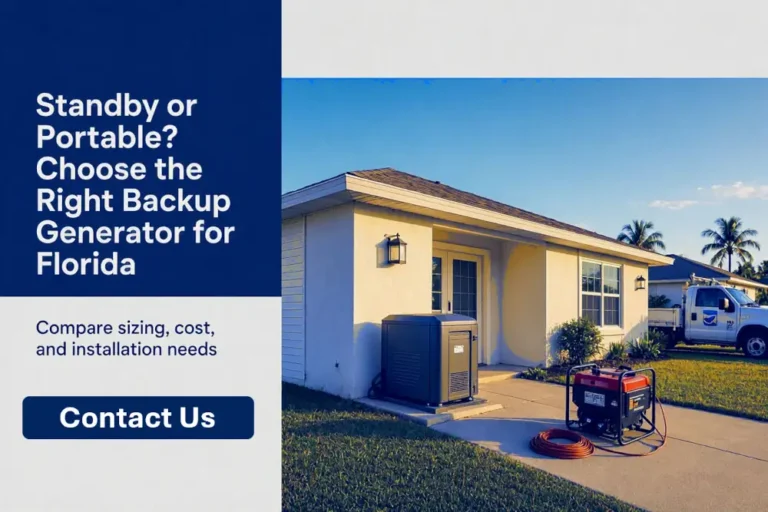
Southwest Florida Home Backup Power Options:
Questions and Answers on Costs and Installation
Standby/Pad Mounted Generator Questions
Question: What should I consider when choosing between a standby whole-house generator and a portable generator?
Quick Answer: The biggest difference between choosing to invest in a standby and portable generator for emergency needs is the cost to buy, the cost to operate, and what you consider important to remain powered in your home.
More Detail:
First, decide whether whole-home backup power is worth the higher cost. Standby generators respond quickly during outages—usually within seconds—and can provide longer-lasting power. When connected to natural gas, they can run for days because the fuel supply is effectively continuous. With liquid propane (LP), or in some cases diesel, run time depends on stored fuel capacity and how quickly it can be replenished.
Portable generators typically cost less to purchase and install. They can be less convenient because they require regular refueling—sometimes every hour or every few hours, depending on generator capacity and the household load. However, if you power only essential items, a portable generator can run for several hours continuously without refueling. We can help you choose the right size portable generator for your needs.
Question: How do I determine what size standby generator I need?
Quick Answer: Generator manufacturers typically recommend a product size range based on your home’s service panel main breaker ratings. It is possible to choose to only support essential loads and not the whole home, reducing the capacity needed.
More Detail:
For standby whole-home generators, you usually do not need to calculate every individual electrical load unless you want a custom-optimized system. Manufacturers typically size units based on your main service capacity—such as 100, 150, or 200 amps—and whether you want whole-home coverage or managed essential-load coverage. While there is no exact formula that matches generator size to service panel capacity, smaller models of about 10 kW to 15 kW can support many 100-amp homes. Many 200-amp homes can be backed up by generators in the 18 kW to 25 kW range, and sometimes up to 30 kW. Recommended size may increase if you choose a liquid-cooled model instead of an air-cooled one. Liquid-cooled generators use larger, automotive-style engines, making them better suited for demanding conditions and extreme climates. They generally start around 22 kW to 25 kW and scale much higher for industrial applications.
Question:What does an electrician need to do to prepare my standby generator for service?
Quick Answer: After the generator is placed, your electrician completes the permanent power connection and ensures all Florida code permit and inspection requirements are met.
More Detail:
Choose and consult an electrician while selecting your standby generator so they can confirm it is compatible with your existing electrical system. In some cases, your electrical panel may need an upgrade to meet code requirements or safely handle the added capacity. Electrical work typically begins after the mounting pad is complete and the connection location is clear. In most installations, the generator is already placed and secured on the pad. The electrician then makes the permanent connection between the generator and the home and installs an interlock or automatic transfer switch (ATS), which allows the generator to provide hands-free backup power during an outage.
Your electrician should obtain the necessary permits before work begins, schedule all required inspections, and understand Florida Building Code (FBC) Chapter 27, which governs electrical work.
Question: What is the typical cost to buy and install a standby generator?
Quick Answer: In Southwest Florida, the typical range for your total standby generator installation cost will vary from $12,000 up to as high as $30,000. For large homes with greater than 150 to 200 amp service, prices may be higher.
Portable/Removable Generator Questions
Question: How do I choose the right size portable generator?
Quick Answer: Start by identifying the appliances and services you want the portable generator to support, then work with your electrician to estimate the required load and choose an appropriately sized unit.
More Detail:
In rare cases, a large portable generator may cover much of your emergency power needs, especially if you run only essential items at one time. Central air conditioning is often difficult to support continuously and usually requires the highest fuel consumption from a portable generator.
The best approach is to work with your electrician to identify the essentials you want powered at the same time, such as selected lighting, refrigerators, internet equipment, or medical devices. Some homeowners also keep a portable or window air conditioner for emergencies. Once those needs are defined, the electrician can calculate or measure the combined running watts and the surge watts required when motor-driven devices start.
Question: What does an electrician need to do to prepare my portable generator for service?
Quick Answer: To prepare for portable generator service, an electrician typically installs an exterior power inlet box near your planned setup location and a manual interlock switch to safely prevent overlapping utility and generator power.
More Detail:
Preparing a portable generator is simpler than installing a whole-home standby system. Typically, an electrician installs a basic manual interlock to prevent the main service and generator from powering the home at the same time. They also mount a generator-compatible power inlet box on an exterior wall, so you should choose where you plan to place the generator when it is taken out of storage. This setup is flexible and may allow you to upgrade to a larger generator later as your backup power needs grow.
Question: What is the typical cost to buy and prepare for a portable generator?
Quick Answer: In Southwest Florida, most home owners select portable generators in the range of 2 kW to 10 kW capacity. Depending on fuel type and whether you prefer a standard or quieter, inverter generator, your total costs ready for service will typically be between $2,000 and $5,000.
Question: Can Koska Electric help me choose a standby or portable generator?
Yes! Koska Electric is eager to offer phone consultations and in-home visits to help ensure your backup power needs are met and your installation goes smoothly.
General Questions About Generators
Question: Are there differences in maintenance and upkeep between standby and portable generators?
Yes, standby generators require calendar based periodic inspections and maintenance actions based on time in use, while portable generators require actions based on time in use as well as time and conditions in storage.
More Detail:
Residential standby generators, including models from Generac and Kohler, need routine maintenance based on self-exercise cycles, scheduled intervals, and total runtime. Recommended upkeep includes checking oil monthly, keeping the unit free of debris, and replacing the oil, filter, spark plugs, and air filter annually or every 100–200 operating hours. To help prevent startup failures during outages, replace the starting battery every 3–4 years.
Portable generator maintenance is based both on operating hours and time in storage. Start with an initial oil change after the first 5–20 hours of break-in, then check the oil before each use. Replace the engine oil and clean the air filter every 50 hours, or every 3–6 months. Each year, or after 100 hours of use, inspect the spark plug and spark arrester. To prevent carburetor damage during storage, either add fuel stabilizer or drain the gasoline, since untreated fuel can sour when left unused.
Question: How long do standby and portable generators last?
Standby backup generators typically last 20–30 years, or about 1,500 to 3,000+ operating hours. Portable generators usually last 5–10 years, or roughly 500 to 1,500 operating hours, depending on fuel type, storage environment, and maintenance.
More Detail:
As with maintenance, storage conditions play a major role in the lifespan of portable generators. Units kept in damp sheds or exposed garages may develop rust, corroded electronics, or poor performance before the engine itself wears out.